
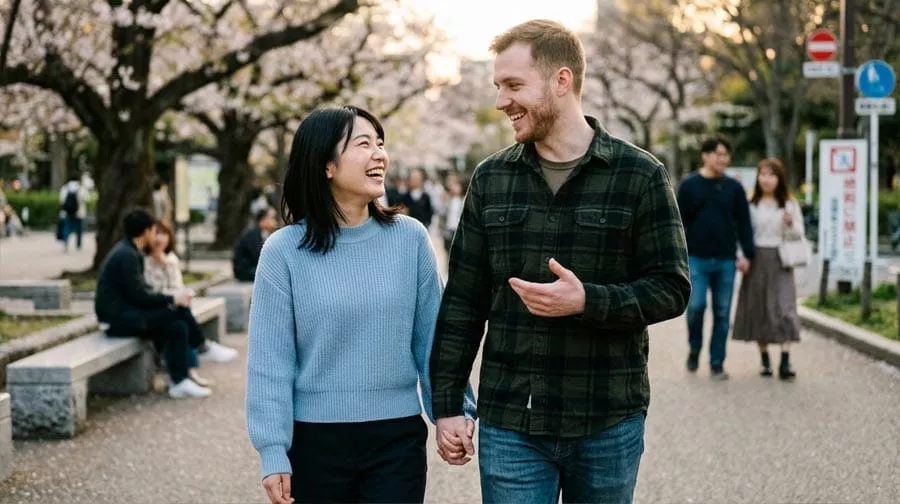
Trust forms the foundation of every strong relationship. Trust is essential for emotional connection to develop. Trust makes love more profound, more secure, and more meaningful. Trust in Japanese relationships may take a long time to establish.
To people of Western cultures, this may seem quite a shock. In Western relationships, emotional Openness occurs early on. Feelings can be expressed quickly by people. They can show interest verbally and directly. The way Japanese people do relationships can differ.
Trust builds slowly. It is developed with consistency, patience, respect, and shared experiences. In Japan, actions are observed over time rather than words, and it is better to watch than to hear. Trust forms the foundation of every strong relationship.


Harmony, respect, and emotional balance are very important elements in Japanese culture. For this reason, many give thought to not hastening emotional closeness. They prefer to understand someone gradually before opening up completely. Trust is not easily granted. Rather, it is acquired by behavior.
Therefore, first impressions matter, but long-term behavior matters even more.
While physical touch is significant in many cultures, verbal communication is a key aspect of romance in others.
Some people comment on:
Words have power. In many Japanese relationships, nonverbal communication is more significant than verbal communication.
A partner may show care by:
These actions communicate sincerity. This means that Trust is built naturally.
Consistency matters greatly. Trust builds up when actions are consistent over time.
Some examples of reliability are:
These behaviors create safety. Safety encourages vulnerability. If a person feels emotionally safe, they start to open their heart. So, if consistency is the path to intimacy, that's what happens. It's better to take small steps than big steps. That's why Trust is a gradual process but one that is strong.
The initial impression is that the Japanese partners are reserved. This is not to say that they don't feel emotions. Sometimes they just need to express feelings. Many like to watch the character, rather than being vulnerable.
They might question themselves:
These are important questions to consider. As Trust builds, walls of feelings diminish. This will lead to more relaxed and open communication. This involves a slow process.
When it comes to emotional connection, there is a fine balance to be struck: don't rush it - it can make people feel uncomfortable. Rather, when space is given, the connection may be enhanced instead.
Fences are significant in the matter of Trust. Personal space is a valued aspect of Japanese relationship culture. This means emotional and physical limits.
A healthy boundary awareness involves:
This respect conveys maturity. It also demonstrates emotional intelligence. Respects boundaries therefore increases Trust. Conversely, it's possible to lose people's Trust very easily by applying pressure. Thus, patience is a must.
Trust is not developed in the mere act of talking. Common activities foster bonds of emotion. Quality time together leads to an understanding of the other.
Examples include:
These moments reveal character. They demonstrate a person's response to stress. They also display emotional maturity. Hence, Trust is based on the real life experiences. This type of Trust is more likely to last.
In all relationships, honesty is of the utmost importance. But honesty is quite subtle and usually looks calm in Japanese relationships. Individuals may be careful in their relationship to keep harmony. This isn't about suppressing the truth. However, it's about speaking the truth with respect.
Good communication involves:
This reduces conflict. It also prevents emotional damage. Consequently, they both feel secure expressing difficult thoughts. Honesty builds Trust when in a respectful manner rather than an aggressive manner.
Quick attraction isn't necessarily thrilling. But attraction is not enough to keep love alive. Trust does. Slow trust building means that the relationship will often have more solid ground.
Slow trust-building benefits include:
These advantages have significance in the marital relationship. Over time, relationships can be a challenge. The stresses of distance, work, and family all try connection. Trust is an essential factor when couples face those challenges together. This is why it's important to take time to build Trust slowly.
Some Western partners may be confused about Japanese dating customs.
They might imagine such things as:
There are times when these assumptions are incorrect. There is no need to be silent if you are not interested. It frequently involves observation. A Japanese partner might just be taking a chance to gauge Trust.
It is important to know this cultural difference so that there is no confusion.
These practices build intercultural interactions.
Patience and sincerity are key factors if you want to establish a sincere cross-cultural relationship with a Japanese woman.
Transpacific Marriage Agency can help you begin that journey.
Transpacific Marriage Agency (TMA) has specialized in introducing Japanese women to Western men for dating, romance, love, and marriage. TMA's Japanese women clients are among the most beautiful women on earth, both in appearance and in their supportive attitudes toward men. If you seek a sincere relationship built on trust, commitment, and lasting love, Transpacific Marriage Agency can help you find the right partner.
Trust grows through consistent actions, patience, respect, and emotional reliability over time in relationships.
Many express affection through actions, consistency, and care rather than frequent emotional verbal expression.
Boundaries create comfort, safety, respect, and stronger emotional trust between both relationship partners gradually.
Yes, patience, understanding, and consistent behavior help build deep trust across cultures successfully.
TMA connects sincere Western men with Japanese women seeking love, commitment, and lasting marriage together.